AI-Powered Safety·6 min read
Why Voice-First Reporting Beats Forms for EHS
Typing kills frontline adoption. BLS data shows 2.8M US injuries in 2022, with underreporting studies saying the true count is higher. Voice fixes it.
7 Apr 2026
Multi-site, multi-contractor, hi-vis at every level. JSA, fall protection, scaffold permits, and contractor onboarding in one platform that works on a phone, offline if the connectivity drops.
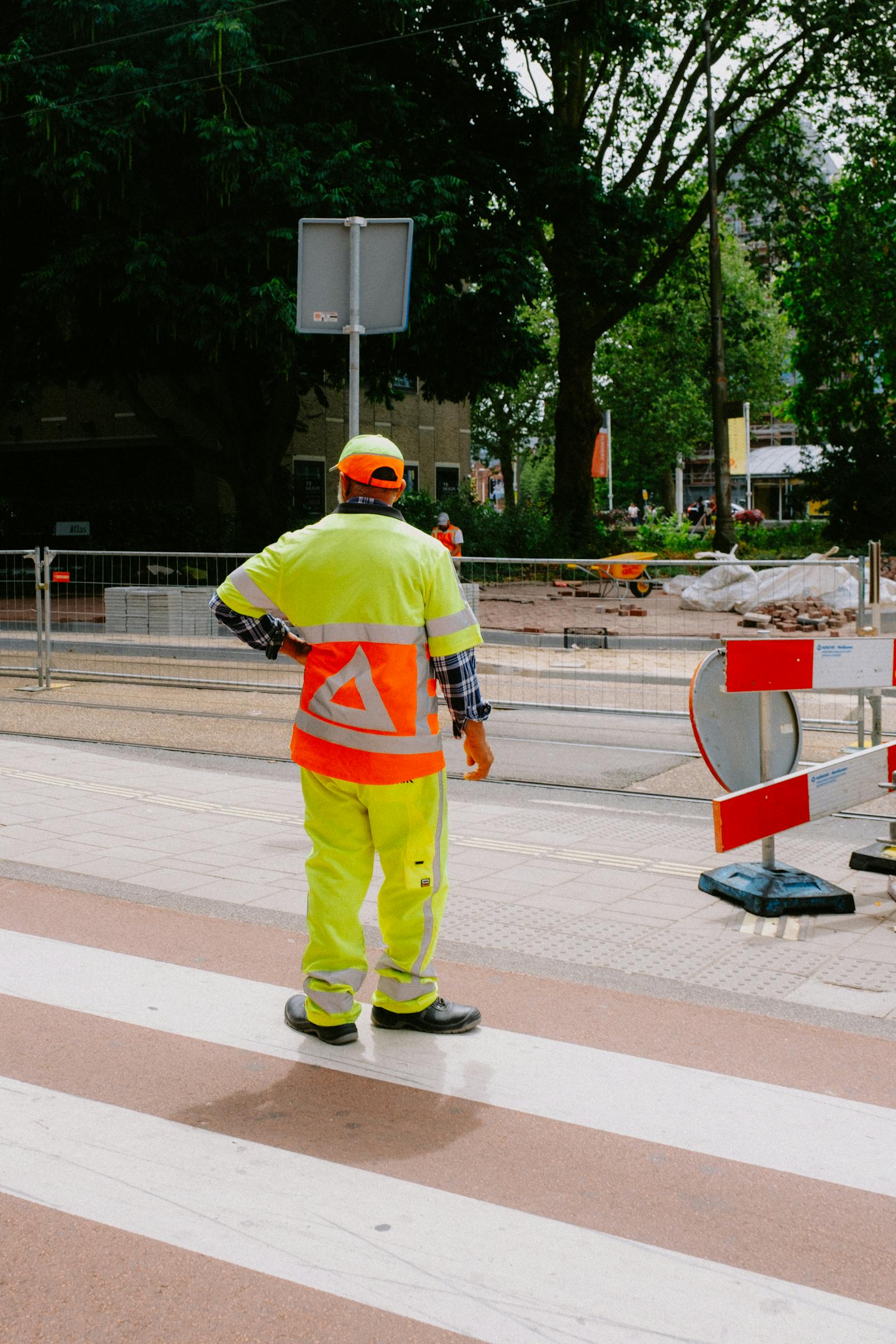
Construction is the most hazardous industry in the US economy by recordable rate and by fatality count. The OSHA "Fatal Four" (falls, struck-by, electrocution, caught-in/between) account for roughly 60 percent of construction worker deaths each year. The work is multi-trade, multi-employer, and constantly changing as the build progresses, which compounds every safety challenge that fixed-facility industries face.
EHS programs built for office work do not survive on a construction site. Tools that require typing, app-store downloads, or constant connectivity get abandoned within the first week. HaloEHS is built for the site: voice-first capture, offline PWA, mobile-first PTW, and contractor onboarding workflows that do not require an IT ticket.
Six hazard categories the platform is built to capture, investigate, and close.
Roofs, scaffolds, ladders, leading edges. The single most common construction fatality cause. Requires permit-to-work and continuous observation discipline.
Falling tools, swinging loads, vehicle backing zones. Requires real-time hazard reporting and layered controls.
Live circuits during MEP work, overhead lines near crane operations. LOTO discipline and isolation verification matter most here.
Cave-ins, atmospheric hazards in deep excavations. Permit-to-work plus competent-person verification on every entry.
Concurrent operations create permit-overlap hazards. Heat-map visualization prevents trades from working under hot work or live electrical.
Hundreds of subcontractor workers per month rotating on and off site. Training records, induction status, and competency proofs must be tracked.
Three structural facts about construction make office-grade EHS programs fail on site. First, the workforce is mobile and multi-employer; on a typical large project, fifty subcontractor crews may rotate through over the project lifecycle. Second, the work environment changes daily as the build progresses, so the hazard register is never static. Third, the work happens away from desks, and most workers do not carry laptops.
The result for paper or office-grade digital programs is predictable: hazards go unreported, permits sit in trailers, JSAs become file-cabinet artifacts, and the site safety manager spends most of the week chasing signatures rather than walking the site.
Voice-first observation reporting removes the typing barrier that kills frontline adoption. A worker on the deck of a 14th-floor pour can describe a hazard in twenty seconds, in their primary language, without taking off a glove. OSHA's most-cited construction standard year after year is Fall Protection (29 CFR 1926.501), with thousands of citations issued annually; capturing the near-misses upstream is the only practical way to predict and prevent the falls themselves.
Mobile permit-to-work with QR-based access makes PTW practical for the crew, not just the office. Permit heat maps show where concurrent operations create overlap hazards (hot work near electrical, lifting over personnel), and the system flags conflicts before the permits are issued.
Contractor onboarding is built into the platform: induction status, training records, competency proofs, and time-bound access are tracked centrally. A subcontractor showing up Monday morning either has the records or they do not, and the gate enforcement is digital rather than discretionary.
A finding on Site A often signals a systemic factor that applies to Site B. Without a system that surfaces the connection, each site investigates independently and the same root cause is rediscovered. Recurrence detection across sites is built into HaloEHS incident management; when a new investigation matches a previously closed root cause on any site in the operation, both the investigator and the corporate safety lead are flagged.
CAPA assignment crosses subcontractor boundaries. If the corrective action is "retrain all rigging crews on tagline use," the system tracks completion across every subcontractor on the affected sites and surfaces any gaps before the next high-risk lift.
Construction is structurally different from general industry because a single worksite typically hosts multiple employers simultaneously. The OSHA Multi-Employer Citation Policy (CPL 02-00-124, 1999) categorizes employers in four roles for citation purposes: Creating Employer (caused the hazard), Exposing Employer (its employees are exposed), Correcting Employer (responsible for fixing it), and Controlling Employer (general site authority, typically the GC). Any single employer can be cited under multiple categories on the same incident.
The general contractor is almost always classified as Controlling Employer and inherits significant liability for hazards across all subcontractor work. Worker compensation insurance carriers price construction risk against this framework: a GC with documented hazard-tracking and subcontractor-management evidence pays a lower experience modifier (EMR) than one operating on paper. The Bureau of Labor Statistics reports construction private-industry fatality rate at 9.6 per 100,000 full-time workers (2022), the highest of any major industry classification.
EHS programs that fail to track which subcontractor created which hazard, which crews were exposed, and which corrective actions actually closed are not just creating safety risk — they are creating uncovered legal exposure. HaloEHS captures employer attribution at the point of observation, attaches it to incident records, and produces multi-employer-aware audit exports. When a citation arrives, the GC can reconstruct who was responsible at every step in the evidence chain, which fundamentally changes the negotiation. The system also tracks subcontractor performance over time — qualification status, training currency, citation history on prior projects — so future bidding can price safety risk accurately.
The HaloEHS modules most directly relevant to construction operations.
Empower every worker to report hazards in seconds. AI auto-classifies and routes observations for review, with anonymous reporting built in.
From first report to verified closure. AI-generated titles, 5 Whys and PEEPO investigation, CAPA generation, and recurrence detection across history.
Your command center for every CAPA across every module. Personalized task lists, automated reminders, evidence-based closure, and effectiveness tracking.
Standards and regulations the platform is built to evidence.
Yes, and this is essential on construction sites where connectivity is unreliable for much of the build. HaloEHS is a Progressive Web App with full offline support: observations, JSAs/JHAs, toolbox-talk sign-offs, inspections, and permit acknowledgements can all be captured with no signal and sync automatically the moment the device reconnects. A worker in a basement, a lift shaft, a tower crane, or a remote groundworks area can still file a report or sign onto a permit without waiting to find coverage. Nothing is lost and nothing requires the worker to remember to re-submit later — the record queues locally and uploads in the background, so the data reflects what actually happened in the field rather than what someone reconstructed at the site office afterward.
Construction depends on a rotating subcontractor workforce, so onboarding has to happen before anyone reaches site. Subcontractor workers receive a digital induction link in advance: they complete site-specific orientation, sign the required acknowledgements, and upload competency certificates, trade tickets, and medical clearances from their own phone before arrival. HaloEHS validates that the documents exist and tracks their expiry, automatically flagging anyone whose certification lapses mid-project. Access permissions are time-bound to the contracted work window, so a subcontractor is only "active" on site for the period they are engaged. This replaces the paper induction binder at the gate and the spreadsheet of certificate expiries, and it means a supervisor can see at a glance who on site today is fully cleared to work.
Yes. The full permit-to-work lifecycle — request, risk review, approval, issuance, acknowledgement by the workers covered, and closure — runs on a phone, with QR-based access so a worker can pull up the active permit for an area by scanning a posted code. Critically, HaloEHS shows permit overlap hazards on a visual heat map and flags conflicts before a permit is issued: hot work scheduled near oxygen or fuel storage, lifting operations over occupied work areas, or simultaneous activities that should never share a zone. On a busy multi-trade site, this simultaneous-operations (SIMOPS) conflict detection is exactly the failure mode that paper permit boards miss, because no single person is holding every active permit in their head at once.
For a contractor running many concurrent projects, corporate dashboards roll up observations, incidents, audits, and open actions across every active site into one view, with the ability to drill from the portfolio level down to a single permit on a single project. Recurrence detection runs across sites, not just within them, so a hazard pattern appearing on three different projects — a particular subcontractor, a recurring equipment fault, a repeated procedural gap — surfaces as a systemic signal that single-site analysis would never reveal. Site hierarchies are fully configurable to match how you actually organize work, whether that is by region, project type, business unit, or subcontractor group, so corporate HSE, regional managers, and individual site teams each see the slice relevant to them.
HaloEHS structures incident data for OSHA recordkeeping from the moment of capture, so the regulatory output is a by-product of normal work rather than a year-end scramble. It generates OSHA Form 300 (the log of work-related injuries and illnesses), the 300A annual summary, and the 301 incident report directly from the incident records, with recordability determinations documented under 29 CFR 1904. Audit-ready exports cover the five-year retention window the standard requires, and because every classification decision is logged with who made it and when, you can defend how each case was treated if an inspector questions it. For construction specifically, this removes the common risk of an incomplete or reconstructed 300 log being discovered during an OSHA visit.
A single-site or single-project cloud deployment is typically operational within two to four weeks, because the heavy lifting is configuration (sites, roles, permit types, induction content) rather than custom development — the core construction templates ship ready to use. Multi-site enterprise rollouts depend on integration scope; connecting HRIS, ERP/asset systems, and your identity provider, plus security review, usually means full rollout in roughly eight to twelve weeks. On-premises or private-cloud deployments for organizations with data-residency requirements add provisioning time inside your infrastructure. In all cases there is no twelve-to-eighteen-month consulting engagement of the kind legacy EHS suites demand; the model is to go live on a pilot project, prove the workflow, and expand.
Typing kills frontline adoption. BLS data shows 2.8M US injuries in 2022, with underreporting studies saying the true count is higher. Voice fixes it.
Near-misses outnumber major injuries 300 to 1 (Heinrich, 1931). The reporting program that captures them prevents the next incident. Here is how to build one.
How to run incident investigations that prevent recurrence. The 5 Whys finds root cause, PEEPO finds blind spots, and BLS data shows 2.8M reasons it matters.
LOTO, machine guarding, ergonomics, near-miss capture, and audit-ready records. HaloEHS fits the line, not the office.
Process safety management, hot-work permits, confined-space entry, contractor management. HaloEHS is built for the consequences of getting it wrong.