AI-Powered Safety·6 min read
Why Voice-First Reporting Beats Forms for EHS
Typing kills frontline adoption. BLS data shows 2.8M US injuries in 2022, with underreporting studies saying the true count is higher. Voice fixes it.
7 Apr 2026
LOTO discipline, machine guarding, ergonomics, near-miss capture. Built for the floor, the maintenance bay, and the audit-ready record at the end of the shift.
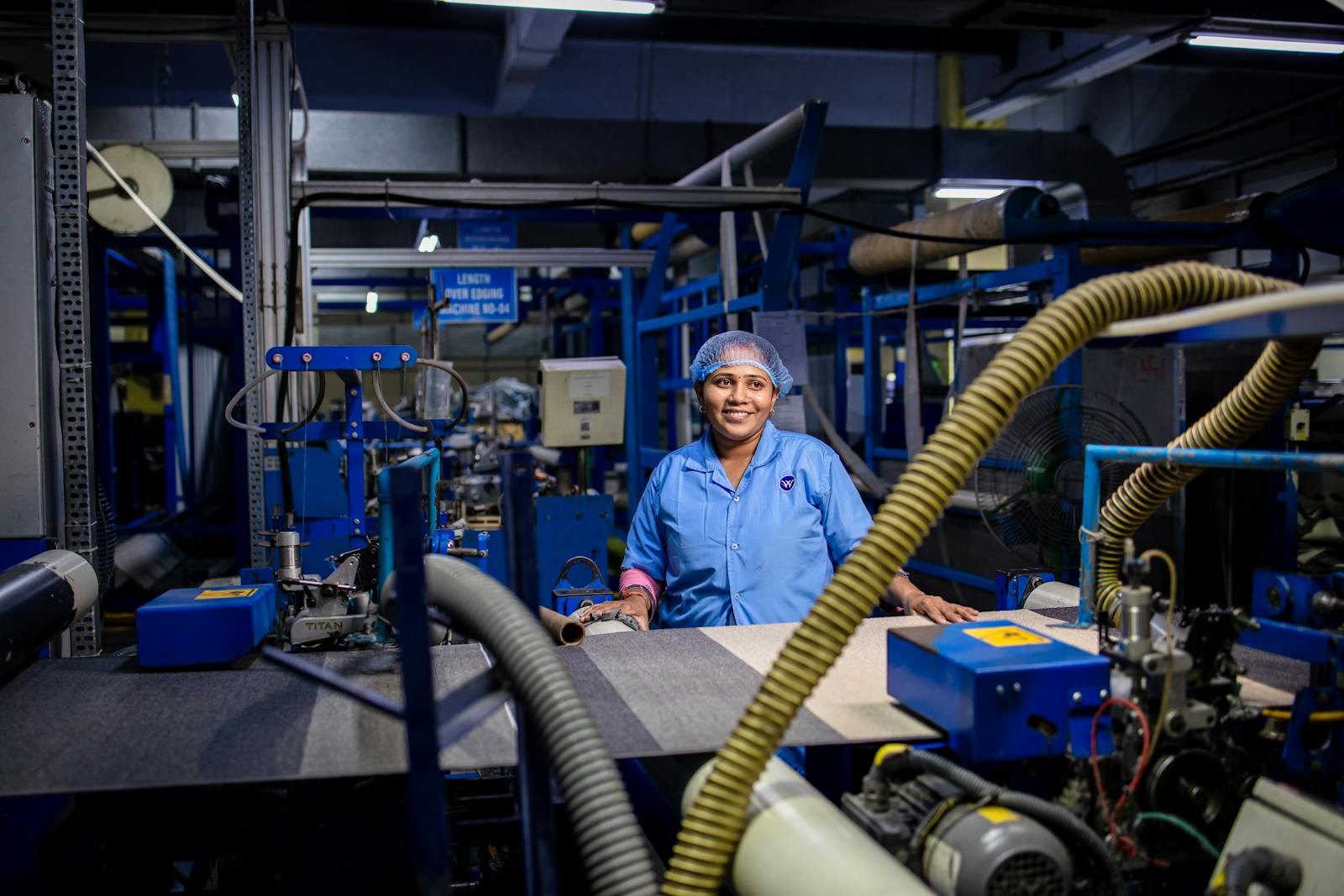
Manufacturing operations face a different EHS challenge from construction: the work environment is comparatively stable, but the consequences of a single moment of inattention are severe. Lockout/tagout (LOTO) is the single most cited OSHA standard in general industry year after year. Machine-guarding violations are not far behind. The hazards are well-understood; the failures come from gaps in workflow discipline, not from gaps in the standards.
The 2022 [BLS data](https://www.bls.gov/news.release/osh.htm) recorded 421,400 nonfatal manufacturing injuries and illnesses, a rate of 3.6 per 100 full-time workers. The cost ceiling is set by the 2024 Liberty Mutual Workplace Safety Index at $58.5 billion per year for US disabling injuries across all industries. Manufacturing is a meaningful share.
Six hazard categories the platform is built to capture, investigate, and close.
Unexpected energization during maintenance is a top cause of severe injury. LOTO procedure compliance must be verifiable, not just signed.
Removed guards, defeated interlocks, point-of-operation exposure. Inspection cycles and immediate observation reporting catch these.
Cumulative trauma disorders develop over months. Pattern detection across observations surfaces problem stations before injuries.
Solvents, coolants, fume hoods. SDS access, training records, and exposure-monitoring data tracked in one place.
The moments when production stopped because something nearly went wrong. The highest-value data points in the operation if they are captured.
Slips, trips, falls from poor housekeeping. Walk-around inspections with mobile capture make degradation visible before injury.
Frontline operators are not typing on phones. Process technicians are not opening laptop forms. The work cycle does not allow it. The result is the same friction problem that kills construction-site reporting: near-misses go unreported, hazards stay invisible, and the safety program runs on the visible fraction of what happens on the floor.
The Bird study (1969), analysing 1.7 million accident reports, refined the Heinrich ratio with a more granular pyramid. The principle is universal: hundreds of small events precede every major one. Programs that capture those small events through frictionless reporting see incident rates decline within twelve to twenty-four months. Programs that do not, do not.
Voice-first observation reporting fits the cycle time of a real production line. An operator with twenty seconds between cycles can describe a hazard, near-miss, or 5S degradation in a single voice note. AI handles transcription, classification, and routing.
LOTO and machine-guarding inspections move from paper checklists to mobile-first checklists with photo evidence at every step. The verification record is queryable from the moment it is completed, not from the moment someone transcribes the binder.
Recurrence detection across the historical record surfaces patterns: the same station showing up across multiple ergonomic complaints, the same shift showing up across multiple near-misses, the same root cause showing up across closed CAPAs. Each pattern is a chance to intervene structurally.
Manufacturing operations that run continuous-improvement programs (Lean, Six Sigma, TPM) have an existing culture of structured root-cause analysis. HaloEHS builds on that culture rather than competing with it. The 5 Whys and PEEPO frameworks already used in quality-engineering investigations apply directly to safety. The same investigators, the same evidence discipline, and the same closure rigor produce safety improvements alongside quality improvements.
CAPA aggregation across modules (safety incidents, quality non-conformances, audit findings) into a single corrective-action queue means owners see one task list rather than three. Closure verification with evidence is enforced uniformly.
Modern manufacturing operations measure productivity through Overall Equipment Effectiveness — the product of Availability, Performance, and Quality. The relationship between EHS performance and OEE is direct but often overlooked. Safety incidents drive unplanned downtime: a recordable injury triggers area shutdown, incident investigation, OSHA notification (for serious cases), and corrective action. A single moderate injury can cost a production line 8 to 16 hours of availability.
Smaller events compound. Line-stop near-misses, machine-guarding adjustments, LOTO completions, and 5S degradation events each individually cost minutes to hours, and collectively cost several percentage points of OEE. The 2024 Liberty Mutual Workplace Safety Index estimates US disabling injury cost at $58.5 billion annually; for a specific plant, the slice attributable to recordable incidents is typically 4 to 9 percent of total operating cost.
Plants with mature EHS programs — voice-first observation, recurrence detection, evidence-based CAPA — typically report 5 to 8 percent OEE gains within 18 months, with the gain coming primarily from reduced unplanned downtime and faster resumption after stoppages. The mechanism is simple: a 20-second voice observation that catches a fraying guard before it fails prevents the 4-hour line stop the failure would trigger. HaloEHS surfaces the OEE-EHS correlation on the operational dashboard: which stations show recurring observations, which shifts have higher near-miss density, which incident types are driving the most downtime. Operations directors increasingly co-own these dashboards with the EHS function because the safety data is also operational data.
The HaloEHS modules most directly relevant to manufacturing operations.
Empower every worker to report hazards in seconds. AI auto-classifies and routes observations for review, with anonymous reporting built in.
From first report to verified closure. AI-generated titles, 5 Whys and PEEPO investigation, CAPA generation, and recurrence detection across history.
Your command center for every CAPA across every module. Personalized task lists, automated reminders, evidence-based closure, and effectiveness tracking.
Standards and regulations the platform is built to evidence.
Lockout/tagout procedures are templated per equipment type, so the steps a worker follows match the specific machine rather than a generic checklist. Each critical step — lock applied, stored-energy released, zero-energy verified, isolation confirmed — requires photo evidence before the procedure can advance, which prevents the dangerous shortcut of signing off a step that was never actually performed. Completed LOTOs are queryable by equipment, by date, and by the person who performed them, so when an auditor or an incident investigation asks "show every lockout on this press in the last year," the answer is immediate. Because LOTO failures are among the most frequently cited OSHA violations (29 CFR 1910.147) and a leading cause of serious machine injuries, this verifiable, evidence-backed record directly reduces both risk and citation exposure.
Yes — and on a production line that is the whole point, because an operator who has to walk to a terminal and fill a form simply will not report. Voice-first capture is built for in-cycle reporting: a roughly twenty-second spoken note files a complete, structured observation while the operator stays at their station, with AI handling transcription, classification, and form-fill. HaloEHS also supports QR-coded touch points at each station, so scanning the posted code pre-fills the location and equipment, leaving the operator to add only what they saw. Removing this friction is what lifts reporting volume from the handful of dramatic events to the steady stream of minor unsafe conditions that actually predict the next line injury.
HaloEHS connects to the systems that hold your operational context so safety records are not an isolated island. Standard integrations cover SAP, Oracle, and modern MES platforms via REST API, syncing equipment master data, work-order context, and operator records into the platform. The practical effect is that an observation or incident automatically carries the right machine, line, shift, and work order without anyone retyping it, which makes pattern analysis far more powerful — you can correlate incidents with specific equipment, production runs, or shifts. API access on Professional and Enterprise plans supports custom integrations and export to your BI stack, and for on-premises deployments these integrations run entirely inside your own network against your internal MES/ERP.
Ergonomic risk is tracked both reactively and proactively. Individual ergonomic complaints captured as observations feed the same AI pattern detection as every other report, so when a particular station, task, or shift accumulates recurring musculoskeletal complaints, HaloEHS surfaces the cluster before it becomes a recordable strain injury — which is exactly the kind of slow-building pattern manual review misses. For formal assessment, recognized ergonomic tools such as RULA, REBA, and the NIOSH lifting equation can be templated and run as structured risk assessments against specific tasks. The combination means you catch the early signal from the floor and can then apply a rigorous, documented evaluation to the tasks the data flags as highest-risk.
Yes. Collaborative real-time auditing is a core capability: several auditors can work on the same audit at once — different sections, different areas of the plant — without locking each other out or overwriting each other's entries, which is how large plant audits actually get done within a realistic window. Findings raised during the audit flow straight into the CAPA queue with owners and deadlines, so nothing is lost between the walkthrough and the follow-up. Time-bound external auditor access lets certification bodies or customers conduct their audits inside the platform with permissions that expire when the engagement ends, which supports ISO 45001 surveillance cycles and customer/supplier audits without giving outsiders standing access to your data.
HaloEHS maps to the ISO 45001 clause structure out of the box, so the evidence a certification auditor samples is generated continuously as a by-product of normal work rather than assembled in a pre-audit panic. Documented hazard identification, risk assessment, incident investigation, internal audit, corrective action, and management review all flow into queryable, timestamped records with a complete history of who did what and when. Certification and surveillance audits work by sampling these records and tracing them end to end; programs that can produce the full chain — hazard to risk assessment to control to verification — on demand pass cleanly, while those relying on scattered spreadsheets struggle. The same structured records also support OSHA expectations and customer compliance requests without duplicate effort.
Typing kills frontline adoption. BLS data shows 2.8M US injuries in 2022, with underreporting studies saying the true count is higher. Voice fixes it.
ISO 45001 requires CAPA. Most operations log them; few close them effectively. Here is how to track corrective actions to verified closure and prove the loop.
Near-misses outnumber major injuries 300 to 1 (Heinrich, 1931). The reporting program that captures them prevents the next incident. Here is how to build one.
Process safety management, hot-work permits, confined-space entry, contractor management. HaloEHS is built for the consequences of getting it wrong.
Multi-site, multi-contractor construction operations need EHS that fits the site, not the office. JSA, fall protection, PTW, and contractor onboarding in one platform.