 EHS Operations
9 min read
Incident Investigation: 5 Whys & PEEPO Field Guide
How to run incident investigations that prevent recurrence. The 5 Whys finds root cause, PEEPO finds blind spots, and BLS data shows 2.8M reasons it matters.
Read article
Permits with approval matrices per type and business unit, isolation and entry logs kept against the permit, overlap detection before work starts, and a live map of every active permit across your assets.
Energy and utility work concentrates risk into isolation. Most serious incidents in this sector trace back to an isolation that was incomplete, released early, or believed to be in place when it was not. The paperwork exists precisely to prevent that, which makes the integrity of the permit record the safety control rather than an administrative shadow of one.
HaloEHS runs permit to work as a real state machine with every transition permissioned, logged and signed, and keeps the isolation and entry logs against the permit itself rather than in a separate book.
The screens these operations use most. Live screenshots from a HaloEHS demo workspace, with personal details blurred.
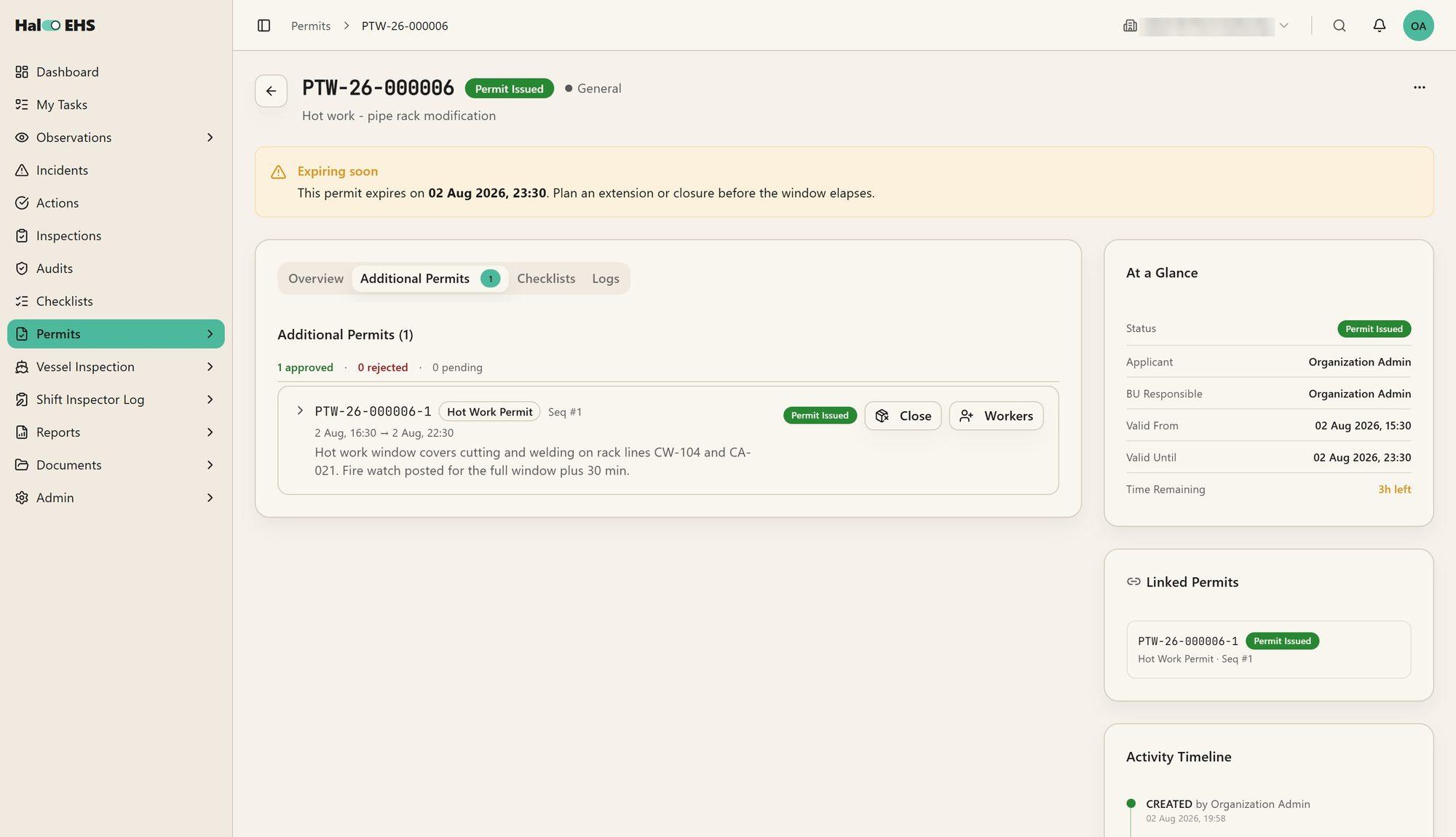
Issued hot work permit with an approved additional permit and its validity countdown
Incomplete or prematurely released isolations are the dominant serious-incident pathway. The record has to be trustworthy in real time.
Work happens across substations, plants and line assets. Nobody has line of sight over all of it from one place.
Conflicting work at the same location is easy to authorize accidentally when permits are issued from different desks.
Not the full catalogue. These are the ones this operation leans on hardest, and each links through to what it actually does.
Digitize the full permit-to-work lifecycle. QR-based access at the point of work, permit heat maps, and SIMOPS overlap detection that flags conflicts before a permit is issued.
Recurring inspection programmes built on versioned checklists, with perform, review and approve chains and findings that become tracked corrective actions.
Empower every worker to report hazards in seconds. AI auto-classifies and routes observations for review, with anonymous reporting built in.
Your command center for every CAPA across every module. Personalized task lists, automated reminders, evidence-based closure, and effectiveness tracking.
Draft, submit, review, approve, acknowledge, work in progress, closure request, closed. Every transition is permissioned and signed, with approval matrices configured per permit type and per business unit so a high-voltage isolation does not follow the same chain as routine maintenance.
Isolation logs, entry and exit logs and work logs are kept against the permit and export as a single PDF. When an investigation asks what was isolated, by whom, and when it was released, the answer is one record rather than three sources that have to be reconciled.
A live map shows every active permit across your assets. For an operation running simultaneous work in several locations, this converts a coordination problem that depended on phone calls into something visible. Overlap detection then flags conflicts before work starts, and overriding it is explicit and logged.
HaloEHS produces the structured, timestamped records these frameworks expect. It is not itself certified against any of them.
The control of hazardous energy standard requires documented energy control procedures, periodic inspection of those procedures, and employee training records.
Read the standardProduct workflows map to the ISO 45001 clause structure, so hazard identification, control, verification and management review generate evidence as a by-product of normal work. HaloEHS itself is not ISO certified.
Read the standardYes, and in this sector that is essential. Approver matrices and workflow steps are configured per permit type and per business unit, so a high-voltage isolation can require a different and deeper chain than a routine mechanical permit. The matrix is enforced on every transition server-side rather than presented as guidance.
An extension is requested through the same approval discipline as the original permit. That is deliberate: the common failure mode in the field is an expired permit quietly kept alive because re-issuing it felt disproportionate. Making extension a first-class, approved transition removes the incentive to let a permit drift past its validity.
We will set the demo up around your sites, your business units and your language, not a canned dataset.