
EHS that travels with the vessel call
Inspections bound to the call, deviations that route to someone who can authorize them, and SLA clocks that flag a breach while it can still be recovered.
Marine operations run on a clock and a crew that changes. Both make record-keeping harder than in a fixed facility: the work is time-boxed, the people doing it rotate, and the language they share is often not the language of the paperwork.
HaloEHS handles the vessel call as its own record with its own lifecycle, and runs in six languages so the person closest to the work can be the person who reports it.
HaloEHS for Marine & Shipping
The screens these operations use most. Live screenshots from a HaloEHS demo workspace, with personal details blurred.
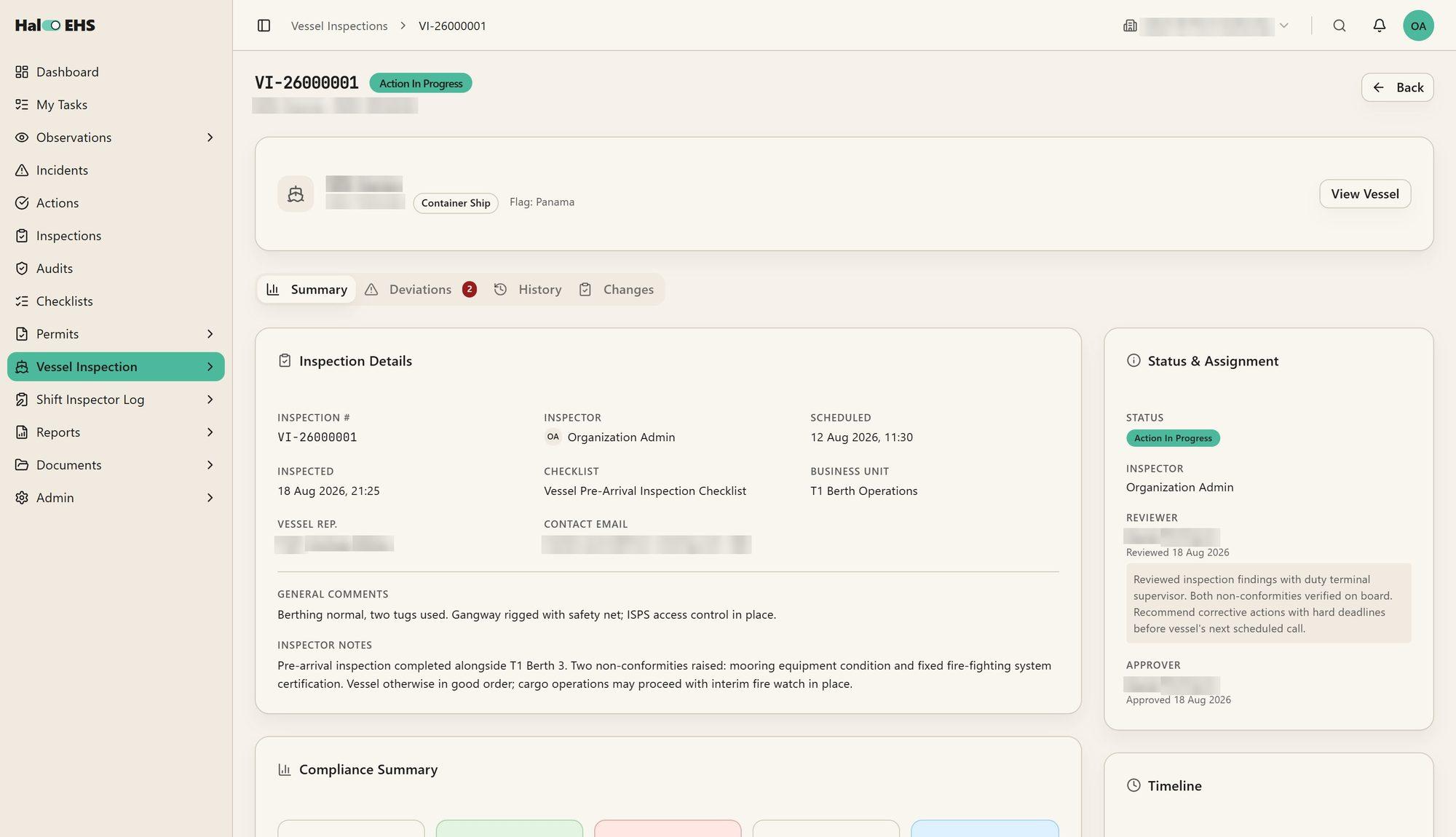
Vessel inspection with deviations and corrective actions
Where Marine & Shipping breaks generic EHS tooling
- 01
Time-boxed operations
Cargo operations run to a schedule with commercial penalties. Any workflow that adds friction gets bypassed.
- 02
Rotating multinational crews
The people on board change between calls and rarely share a first language. Reporting in English only means reporting less.
- 03
Deviations needing a decision
A deviation is not a failed checkbox. It needs an authorization decision from someone with standing, recorded at the time.
The modules that carry most of the weight here
Not the full catalogue. These are the ones this operation leans on hardest, and each links through to what it actually does.
Vessel Inspections
Vessel-call inspections with their own checklists, deviation handling, authorization chains and SLA clocks with breach tracking. Native to the platform, not configured on top.
Shift Operations
Shift inspector logs that open at shift start and lock themselves at shift end, with toolbox talks and a live shift feed. Built for terminals and continuous operations.
Permit to Work
Digitize the full permit-to-work lifecycle. QR-based access at the point of work, permit heat maps, and SIMOPS overlap detection that flags conflicts before a permit is issued.
Observation
Empower every worker to report hazards in seconds. AI auto-classifies and routes observations for review, with anonymous reporting built in.
Deviations are decisions, not flags
Generic inspection tooling treats a non-conformance as a failed item to be reviewed later. In marine operations a deviation frequently needs a call made now, by someone empowered to make it, with the reasoning attached.
HaloEHS routes deviations through authorization chains configured per business unit, so the approver required for a significant deviation is not the same as for a routine one. The decision, the person and the timestamp become part of the inspection record rather than living in a WhatsApp thread.
Six languages, one record
HaloEHS runs in English, Hindi, Tamil, Malayalam, Kannada and Arabic, including full right-to-left layout. For crews drawn from South Asia and the Gulf this is the difference between a reporting culture and a reporting policy. The interface follows the reporter; the underlying record stays consistent for everyone who reviews it afterwards.
The standards this work answers to
HaloEHS produces the structured, timestamped records these frameworks expect. It is not itself certified against any of them.
ISM Code
The International Safety Management Code requires a documented safety management system with recorded non-conformities, corrective actions and reviews. Structured, timestamped records with owner and closure evidence map directly to those expectations.
Read the standardMLC 2006
The Maritime Labour Convention covers occupational safety and health protection and accident prevention on board, including recorded reporting and investigation of occupational accidents.
Read the standard
Marine & Shipping, answered plainly.
Each deviation routes through an authorization chain configured for that business unit, and the outcome is written into the inspection record with the identity of the authoriser and a timestamp. Because the chain is enforced server-side rather than by interface convention, a deviation cannot be quietly closed by someone without the standing to close it.
Yes. The inspection is bound to the call rather than to a fixed schedule, so it reflects the actual sequence of a working call rather than an idealised one. SLA clocks run independently and flag breaches automatically, which means the timing record stays accurate even when the operational order changes.
See your operation in HaloEHS.
We will set the demo up around your sites, your business units and your language, not a canned dataset.