Skip to content
hal
Industry

Many sites, one safety system

Distribution networks run the same operation in twenty places with twenty different standards. Shared checklist templates, scheduled inspections and a business-unit hierarchy make the network comparable to itself.

The operation

The defining EHS problem in logistics is not that any single site is hard to run. It is that a network of sites drifts. Each one develops its own checklist, its own thresholds and its own reporting habits, and by the time a pattern is visible at network level, the data underneath it is not comparable.

HaloEHS makes the template the shared thing. One versioned checklist builder feeds every site, schedules generate the inspections, and the business-unit hierarchy lets a regional manager see their sites while a national lead sees the roll-up, from the same records.

In the product

HaloEHS for Logistics & Warehousing

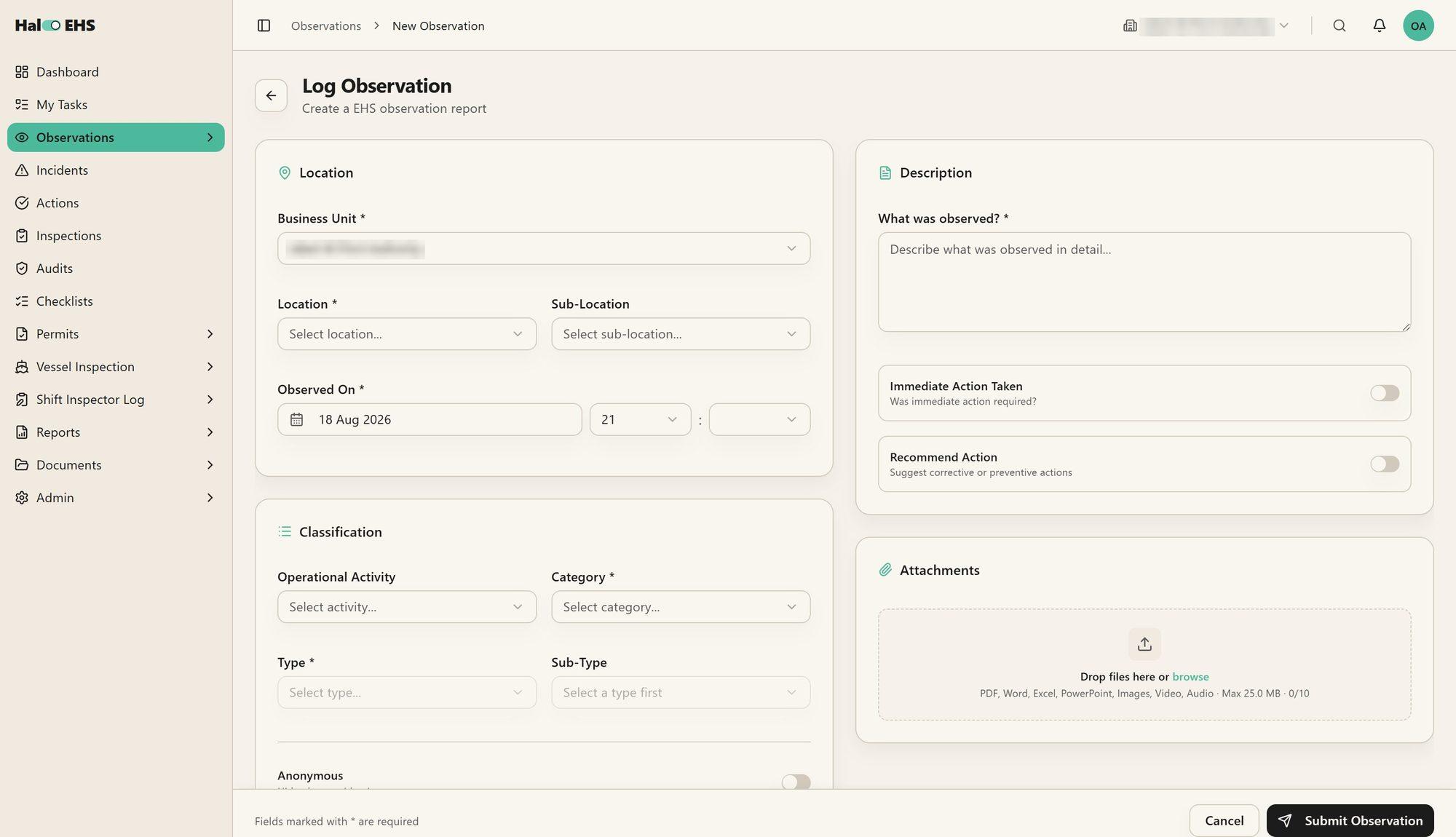
The screens these operations use most. Live screenshots from a HaloEHS demo workspace, with personal details blurred.

app.haloehs.com/observations/new
Observation report form with a live location map

Observation report form with a live location map

What makes it hard

Where Logistics & Warehousing breaks generic EHS tooling

  1. 01

    Pedestrian and MHE interaction

    Forklifts and people sharing aisles is the dominant injury pathway. Observation capture has to take seconds to be used at all.

  2. 02

    Racking integrity

    Damage accumulates invisibly between formal inspections. Scheduled checks plus easy ad-hoc reporting are both needed.

  3. 03

    High turnover and agency labour

    Workers change constantly. Onboarding someone into a safety system cannot require an IT ticket.

Comparability is the whole game

A network where every site uses its own checklist produces numbers that cannot be compared, which means network-level analysis is guesswork dressed as data. Shared versioned templates fix that at the root: the same questions, asked on the same schedule, with results that roll up honestly.

Because templates are versioned, changing a checklist does not retroactively distort past results. The trend line stays readable across a template change, which is exactly when most systems quietly lose continuity.

Reporting fast enough for a live aisle

In a distribution centre the reporter has seconds, not minutes. Guided capture with annotated photo evidence, an AI-drafted title and a predicted risk category means a hazard can be logged without composing prose, and it still reads clearly in the queue a week later.

Agency and temporary workers open it in the browser on the device they already carry. No app store, no install, no account provisioning delay before someone can report the thing they just saw.

Regulatory context

The standards this work answers to

HaloEHS produces the structured, timestamped records these frameworks expect. It is not itself certified against any of them.

  • OSHA 1910.178 (Powered Industrial Trucks)

    Covers operator training and certification, daily pre-use examination of trucks, and recordkeeping for evaluations, all of which map to scheduled inspection programmes.

    Read the standard
  • ISO 45001

    Product workflows map to the ISO 45001 clause structure, generating continuous evidence across multi-site operations. HaloEHS itself is not ISO certified.

    Read the standard
Questions

Logistics & Warehousing, answered plainly.

By making the checklist the shared object rather than the site. Templates come from one versioned builder and schedules generate inspections consistently, so results are produced the same way everywhere. The business-unit hierarchy then scopes who sees what: a site manager sees their site, a regional lead sees their region, and a national lead sees the roll-up, all from the same underlying records rather than from separately maintained reports.

Reporting an observation is deliberately the lowest-friction workflow in the product, including an anonymous option where that is appropriate for the site culture. For workers who need to act inside workflows, such as signing onto a permit, accounts carry role and business-unit scoping so access matches the assignment rather than granting network-wide visibility to a temporary worker at one site.

Related industries

Adjacent operations

Next step

See your operation in HaloEHS.

We will set the demo up around your sites, your business units and your language, not a canned dataset.