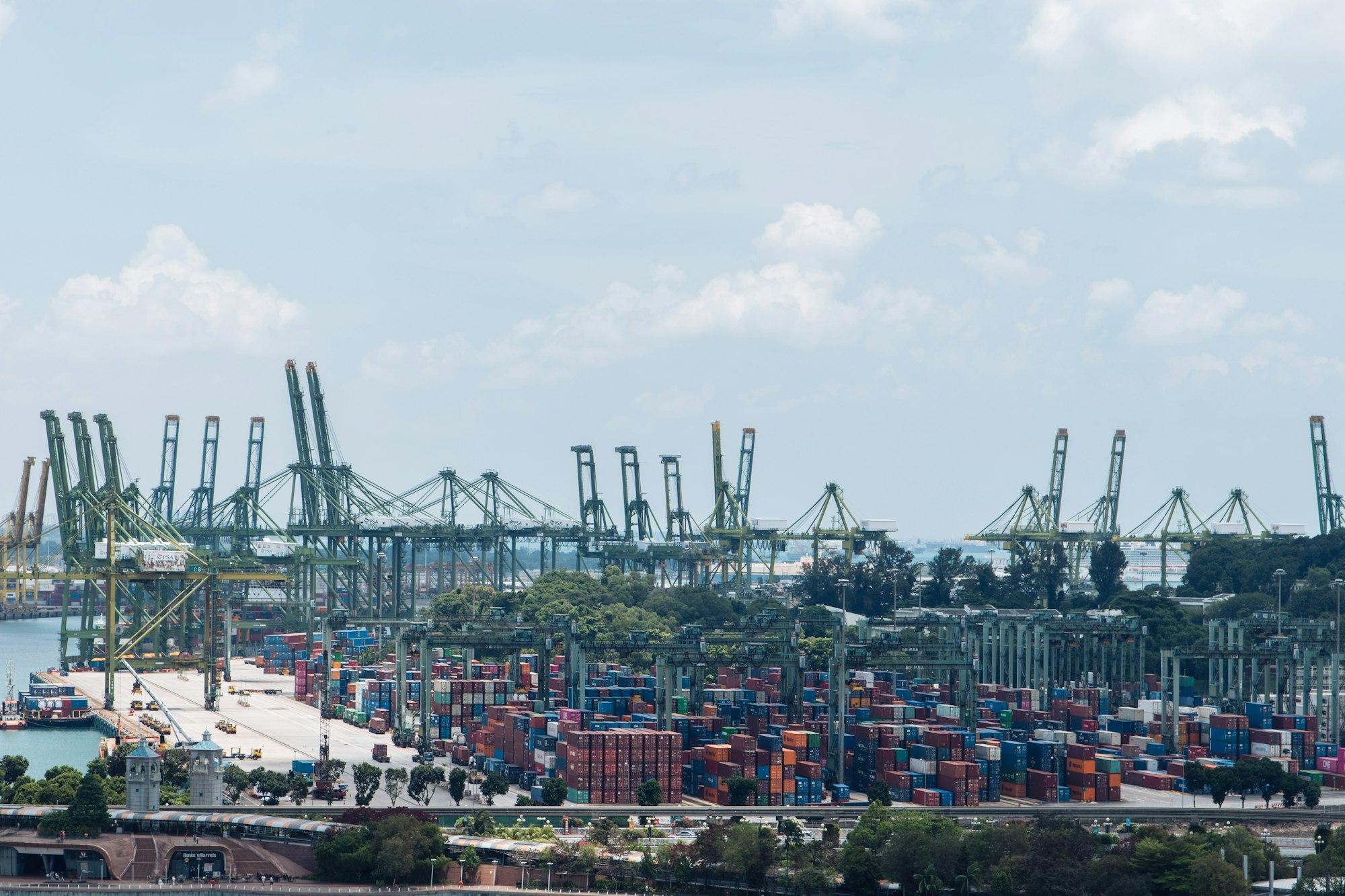
Vessel calls with their own clock
A vessel call is a time-boxed event with money attached to every hour. HaloEHS runs vessel-call inspections as first-class records: their own checklists, deviations with authorization chains, and SLA clocks that track breaches automatically.
Vessel Inspections workflow
- Vessel call
- Inspect
- Record deviations
- Authorize
- Close within SLA
Vessel-call inspections with their own checklists, deviation handling, authorization chains and SLA clocks with breach tracking. Native to the platform, not configured on top.
Vessel inspections do not fit a generic inspection template. They are bound to a specific call, they run against a clock with commercial consequences, and a deviation is not simply a failed checklist item: it is something needing an authorization decision from someone with the standing to make it.
Because ports and terminals are the operations HaloEHS was built around, this is a native module rather than a configuration exercise. The checklist, the deviation path, the authorization chain and the SLA clock are part of the model, which is why the record holds together when a call gets complicated.
Vessel Inspections workflow
- Vessel call
- Inspect
- Record deviations
- Authorize
- Close within SLA
Vessel Inspections, the real screens
Live screenshots from a HaloEHS demo workspace. Personal details are blurred.
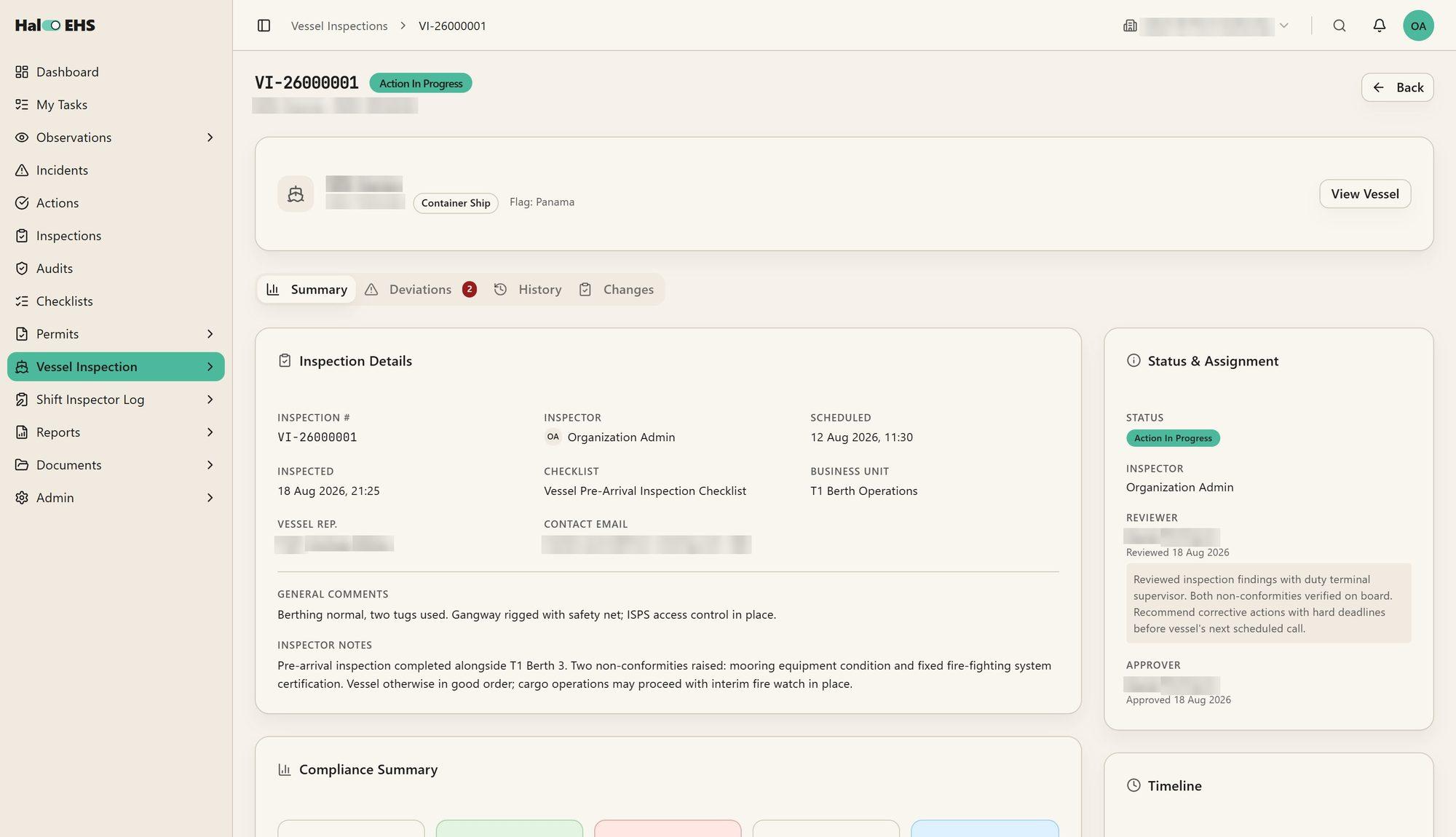
Vessel inspection with deviations and corrective actions
Inside Vessel Inspections
- 01
Vessel-call inspections
Each inspection is bound to a specific vessel call, so the record travels with the call rather than sitting in a general inspection queue. - 02
Deviations with authorization
A deviation routes to someone empowered to authorize it. The decision, the authoriser and the timestamp are part of the record. - 03
SLA clocks and breach tracking
Service-level timings run against the call, and breaches are detected by a scheduled job rather than noticed later in a review. - 04
Generated records
Completed inspections produce system PDF records suitable for the commercial and regulatory conversations that follow a call.
One workflow, start to close.
Every transition is permissioned and logged, so the record shows who moved it, when, and on whose authority.
- 01Vessel call
- 02Inspect
- 03Record deviations
- 04Authorize
- 05Close within SLA
Vessel Inspections record
- Vessel call
- Inspect
- Record deviations
- Authorize
- Close within SLA
Append-only. Every entry keeps who, when and on whose authority.
The wedge nobody else claims
Across the EHS vendors studied for the site research, none claim vessel operations as a native capability on their homepage. The pattern is to offer a configurable inspection module and let the customer build the vessel workflow themselves, which puts the burden of modelling a complex, time-bound, commercially sensitive process onto the buyer.
HaloEHS ships it. That is a narrow claim and a real one, and it is why ports and terminals are treated as the flagship vertical rather than one entry in a long industry list.
Nothing here is a standalone tool.
Vessel Inspections shares one data layer with every other module. Findings become corrective actions, actions land in the same task inbox, and everything feeds the same dashboards and scheduled reports.

Shift Operations
Shift inspector logs that open at shift start and lock themselves at shift end, with toolbox talks and a live shift feed. Built for terminals and continuous operations.
Learn more
Permit to Work
Digitize the full permit-to-work lifecycle. QR-based access at the point of work, permit heat maps, and SIMOPS overlap detection that flags conflicts before a permit is issued.
Learn more
Action Management
Your command center for every CAPA across every module. Personalized task lists, automated reminders, evidence-based closure, and effectiveness tracking.
Learn moreVessel Inspections, answered plainly.
A scheduled job evaluates the SLA settings against the live state of each call, so a breach surfaces on its own rather than depending on someone watching a clock. That matters commercially: a breach noticed during the call can sometimes still be recovered, while a breach discovered in a monthly review is only ever a post-mortem.
Yes. Authorization chains are configured per business unit, so the person who can authorize a routine deviation is not necessarily the person required for a significant one. The chain is enforced server-side, and every decision is captured with the identity of the authoriser and a timestamp.
See your operation in HaloEHS.
We will set the demo up around your sites, your business units and your language, not a canned dataset.