
Skip to content
hal
Flagship Industry

EHS built for terminal operations

Shift logs that open and lock themselves, vessel calls with their own checklists and SLA clocks, and permits with overlap detection across a live quay. These are modules in HaloEHS, not templates you configure.

The operation

Terminal operations break generic EHS tooling in a particular way. Work is continuous, so there is no quiet period in which to catch up on records. Multiple contractors operate in overlapping space, so a permit issued in isolation is a hazard. Vessel calls are time-boxed with commercial consequences, so a workflow that adds minutes costs money in a way an office process never does.

HaloEHS was built around these operations rather than extended toward them. The shift inspector log, the vessel-call inspection and the permit-to-work state machine are first-class modules with their own scheduled jobs, their own authorization chains and their own clocks.

That is a narrow claim, and it is the honest one. Across the EHS vendors surveyed for our positioning research, none claim native vessel and terminal operations on their homepage. Most offer a configurable inspection module and leave the modelling to the buyer.

In the product

HaloEHS for Ports & Terminals

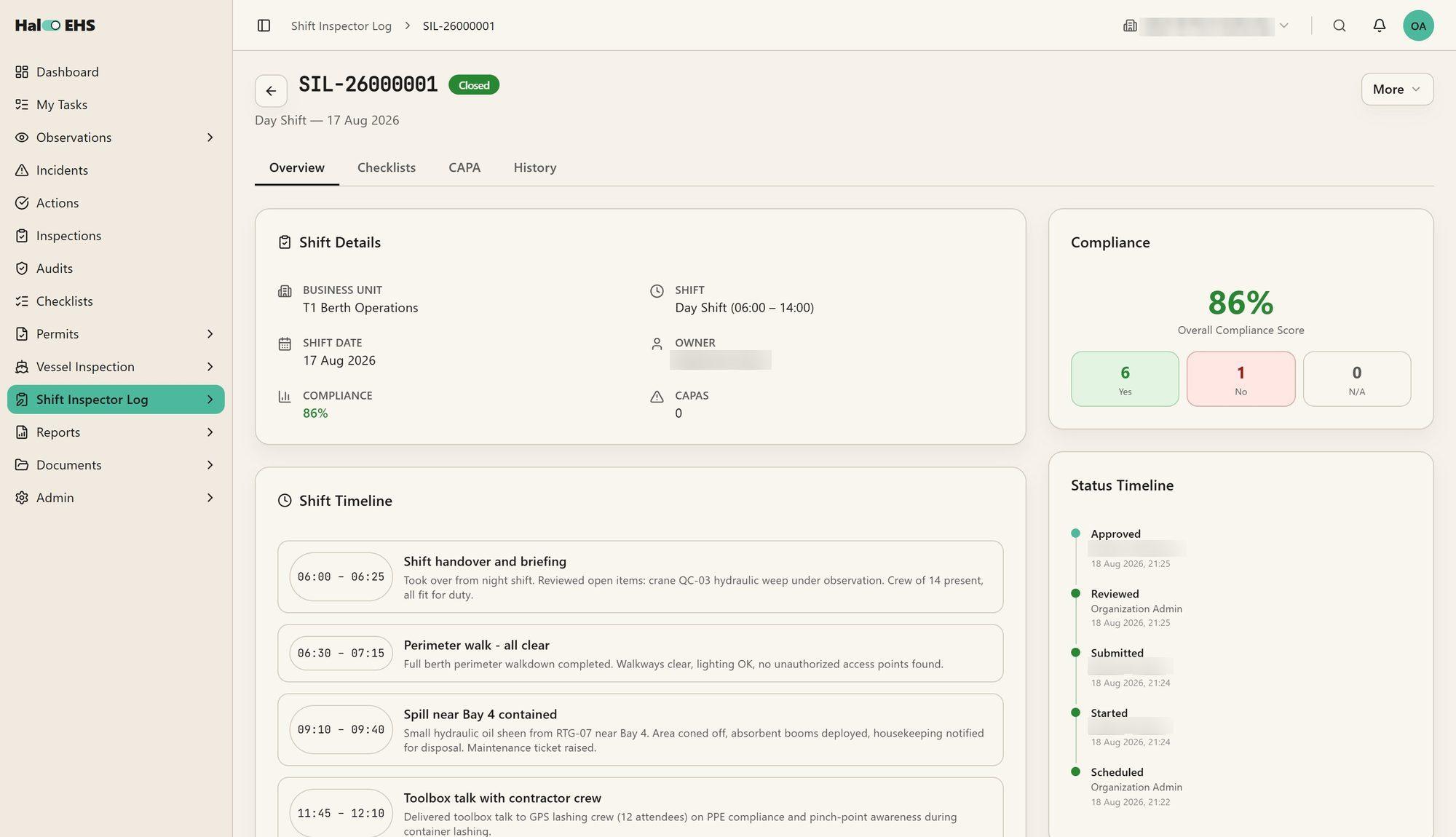
The screens these operations use most. Live screenshots from a HaloEHS demo workspace, with personal details blurred.

app.haloehs.com/shift-log/SIL-26000001
Closed shift log with its timeline, toolbox talk and compliance score

Closed shift log with its timeline, toolbox talk and compliance score

What makes it hard

Where Ports & Terminals breaks generic EHS tooling

  1. 01

    Vessel calls under a clock

    Every hour alongside has a cost. An inspection workflow that slows the call is abandoned, and the record disappears with it.

  2. 02

    Overlapping contractor work

    Multiple parties working the same quay at once. Permits issued without overlap awareness put crews into conflicting work.

  3. 03

    Continuous operation

    There is no downtime in which to reconcile paperwork. If the record is not created during the shift, it is created from memory or not at all.

  4. 04

    Heavy lift and mobile plant

    Quay cranes, reach stackers and yard traffic share space with people. Observation capture has to take seconds, not minutes.

The shift log problem, solved mechanically

In continuous operations the handover is where information dies. A log written at the end of a shift is a memory exercise; a log left open indefinitely is not a record, because anyone can add to it afterwards.

HaloEHS creates the shift inspector log by scheduled job at shift start and locks it by scheduled job shortly after shift end. Between those points it is a live feed the crew can read and add to, so handover is a current picture rather than a summary. Anything that arrives late is a new, separately timestamped entry, which keeps the original record honest about what was known at the time.

Vessel calls as first-class records

A vessel-call inspection is bound to the specific call, carries its own checklist, and routes deviations to someone empowered to authorize them rather than simply flagging a failed line item. SLA settings run a clock against the call, and a scheduled job detects breaches rather than leaving them to be noticed in a monthly review.

The commercial difference is timing. A breach surfaced during the call can sometimes still be recovered. A breach found afterwards is only ever a post-mortem.

Permits on a live quay

Overlap detection flags conflicting work at the same location before it starts, and overriding that warning is an explicit decision with the decision-maker recorded. On a quay running several contractors at once, that is the difference between a permit system and a permit filing cabinet.

Anyone on the apron can scan a permit QR code and see whether it is valid right now, with no account and no app. For contractor-heavy operations that removes the single most common verification failure: nobody could check, so nobody did.

Regulatory context

The standards this work answers to

HaloEHS produces the structured, timestamped records these frameworks expect. It is not itself certified against any of them.

  • ISPS Code

    The International Ship and Port Facility Security Code governs security arrangements at port facilities. Structured, timestamped records of inspections and access control support the documentation expectations that come with it.

    Read the standard
  • ILO Code of Practice: Safety and Health in Ports

    The ILO code covers permit systems, lifting operations, traffic management and contractor coordination in port work, all of which map to permit-to-work, inspection and observation workflows.

    Read the standard
Questions

Ports & Terminals, answered plainly.

They are modules with their own behaviour. The shift inspector log is created and locked by scheduled jobs, not by a user remembering to open and close a form. The vessel-call inspection is bound to a call, carries deviation handling with authorization chains, and runs SLA clocks with automated breach detection. None of that is achievable by configuring a generic checklist, which is why competitors offering only a configurable inspection module cannot match it without custom development.

Permit overlap detection flags conflicting work at the same location before it begins. Overriding that flag is possible, because operational reality sometimes requires it, but it is an explicit and logged decision attributed to the person who made it. Contractors are also first-class permit workers alongside employees and temporary staff, so signing a contractor crew onto a permit does not require creating accounts or raising an IT ticket.

No, and in terminal operations that matters more than almost anywhere else. HaloEHS runs in English, Hindi, Tamil, Malayalam, Kannada and Arabic, with full right-to-left layout for Arabic. A stevedore reports in the language they think in while the record stays consistent for the terminal manager, the HSE lead and anyone auditing later.

Related industries

Adjacent operations

Next step

See your operation in HaloEHS.

We will set the demo up around your sites, your business units and your language, not a canned dataset.